


Why Chemical Dosing Accuracy Is the Hidden Cost Driver in Industrial Water Treatment Plants
Chemical dosing in industrial water treatment is one of those systems that receives less engineering attention than it deserves — until the cost reports arrive.
The focus during plant design typically falls on the major capital items: the clarifiers, the filtration trains, the RO membrane stacks. The dosing system — the skids, the metering pumps, the control valves — is often treated as a procurement afterthought, specified to a line item rather than engineered to a performance outcome. That decision has measurable consequences that show up in quarterly chemical procurement costs, membrane replacement cycles, and treated water quality compliance.
This article examines why dosing accuracy in industrial water treatment is fundamentally a control valve problem, what that means for EPC instrumentation specifications, and what the design parameters look like when you get it right.
What Dosing Inaccuracy Actually Costs an Operating Plant
Inaccurate dosing doesn’t produce a single, visible failure. It operates across multiple cost centres simultaneously — which is precisely why it stays hidden for so long. The four primary cost consequences:
- Chemical overconsumption — The most visible line item. In an RO plant dosing antiscalant, concentration is typically specified at 2–5 mg/L depending on source water chemistry and recovery ratio. A dosing system running consistently 25% above setpoint — not uncommon with poorly characterised control valves — increases chemical spend proportionally. Over a year of continuous operation, that variance accumulates into a procurement figure that the plant operator struggles to explain without tracing it back to the control loop.
- Membrane degradation from scaling — The consequence at the other end of the accuracy problem. Underdosing antiscalant during high-recovery cycles or TDS spikes allows calcium carbonate, calcium sulphate, and silica to precipitate on membrane surfaces. The result is flux decline, increased feed pressure requirements, and membrane replacement ahead of designed lifecycle — a capital cost that originates in a dosing control failure.
- pH instability cascading downstream — In plants using lime or caustic soda for pH correction ahead of coagulation or softening, dosing overshoot drives pH above the optimal coagulation range (typically 6.5–7.5 for aluminium-based coagulants). At pH 8.5 or above, alum and PAC perform poorly. The coagulant dose must be increased to achieve equivalent turbidity removal, generating excess sludge and increasing sludge handling costs. A single poorly controlled dosing loop can inflate costs across three separate chemical line items simultaneously.
- Disinfection residual non-compliance — Carries regulatory exposure in addition to operational cost. Chlorine dosing must maintain a minimum residual at the point of supply without exceeding maximums that create disinfection byproduct risk. Systems that cannot hold setpoint within a tight band force operators to dose conservatively high, incurring both excess chemical cost and increased monitoring burden.
Why the Control Valve Is Where Accuracy Is Won or Lost
The metering pump receives most of the engineering attention in a dosing system — sized, specified, and treated as the primary accuracy instrument. The control valve that modulates flow is frequently selected on generic criteria: pressure rating, connection size, material compatibility. That approach misses the mechanisms that actually determine dosing accuracy in operation.
Parameter | What It Determines | Specification Risk |
Rangeability | Ratio of max to min controllable flow at specified accuracy | Low-rangeability valves lose precision at part-load — the standard operating condition |
Flow Characteristic | How the valve responds to position changes (linear vs. equal %) | Wrong characteristic causes hunting at low flows or sluggish response at high flows |
Actuator Hysteresis | Whether valve holds the same position on opening vs. closing stroke | Introduces dosing variability the control system cannot fully compensate |
Material Compatibility | Service life and leak integrity under chemical attack | Carbon steel or 316 SS in hypochlorite or acid service degrades ahead of maintenance interval |
Shutoff Class | Prevention of siphoning or backflow when dosing system is offline | Under-specified leakage class allows chemical migration into the process stream |
On rangeability specifically: a valve with 10:1 rangeability accurately controls flow across a ten-fold range. A valve with 50:1 rangeability handles full turndown without losing precision. In water treatment dosing, turndown is not a rare operating condition — it is standard. A plant at 60% of design capacity requires proportionally lower chemical doses. If the control valve is sized for peak flow and lacks rangeability for part-load, the operator accepts inaccuracy or trims setpoints manually.
On actuator response: pneumatic actuators with digital positioners can achieve position accuracy of ±0.5% of stroke. Older or generic actuators without positioners exhibit hysteresis that no PID loop can fully correct.
Application-Specific Dosing Control Requirements
Different chemical stages in the treatment train impose different accuracy requirements. The table below summarises the primary differences by application:
Application | Chemicals | Key Accuracy Requirement | Valve Recommendation |
Antiscalant (RO feed) | Polyacrylates, phosphonates | Low-flow precision; tight shutoff to prevent siphoning | Actuated diaphragm or needle valve; PTFE seat |
Coagulant dosing | Alum, PAC, ferric chloride | Rapid response to turbidity changes | Pneumatic actuator with digital positioner |
Disinfection | NaOCl, Cl₂, ClO₂ | Tight setpoint band; reliable shutoff when offline | PTFE-lined diaphragm or PVDF ball valve |
pH correction (caustic) | NaOH, Ca(OH)₂ | Controlled response speed; stem seal integrity | PVDF or Hastelloy C body; verified packing |
pH correction (lime slurry) | Hydrated lime | Slurry compatibility; anti-bridging | Full-bore valve; hard-faced trim materials |
A few application notes worth calling out:
- For antiscalant service, the specific antiscalant formulation should be confirmed with the valve manufacturer — many formulations are proprietary and not covered in standard compatibility charts.
- For hypochlorite service, PTFE-lined diaphragm valves or PVDF ball valves are the standard specification. Hypochlorite is particularly aggressive to valve internals; standard 316 SS seats will degrade well before the designed maintenance interval.
- For lime slurry service, full-bore configurations are required to prevent bridging. Hard-faced trim (Stellite or equivalent) is needed to handle abrasive slurry.
What EPC Instrumentation Specifications Should Include
For EPC contractors finalising instrumentation lists for water treatment projects in the Middle East and Southeast Asia, dosing control valve specifications are typically under-detailed compared to process control valves in the main treatment train. The result is a procurement decision made on price and delivery time rather than performance — and operational consequences that show up after commissioning.
Specification Parameter | Requirement | Rationale |
Cv calculation | At 25%, 50%, and 100% of design flow | Oversized valves near-closed are the most common cause of dosing inaccuracy at commissioning |
Rangeability | Minimum 50:1 for dosing with significant turndown | Eliminates commodity valves that pass a generic spec but fail in part-load operation |
Actuator type | Pneumatic + digital positioner for modulating; solenoid for on/off | Must match plant’s control architecture (4–20 mA, HART, fieldbus) |
Material spec | Body, lining, seat, and stem seal listed separately per chemical service | “SS316 or equivalent” is insufficient for aggressive chemical dosing service |
Leakage class | ANSI/FCI 70-2 Class IV or Class VI for backflow/siphoning risk | Class II or III shutoff allows chemical migration into process when dosing is offline |
Low-flow stability | Manufacturer test data below 10% of rated Cv | Critical for antiscalant and trace chemical dosing applications |
One common specification gap worth flagging: many instrumentation packages specify control valve Cv only at maximum design flow. This passes oversized valves that look correct on paper but operate near closed at typical process conditions — where their control authority is poorest and dosing inaccuracy is greatest.
Vetta Valves in Chemical Dosing Applications
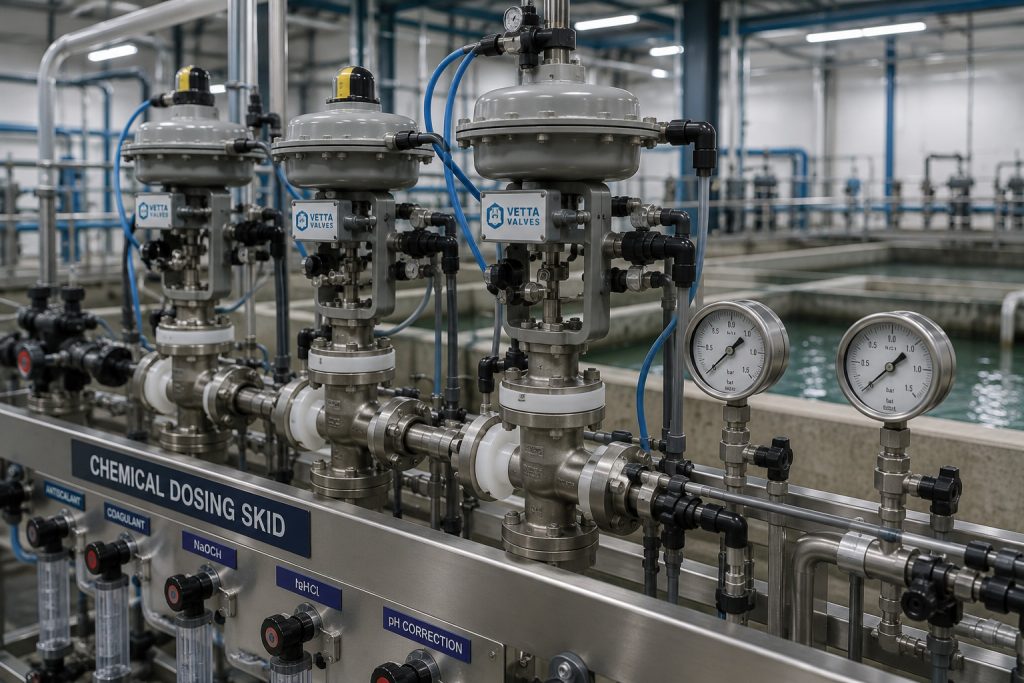
EuroIndustriel’s Vetta Valves range covers the principal valve types used in chemical dosing skids and water treatment plant dosing circuits:
- Pneumatically actuated diaphragm valves — for corrosive chemical service including hypochlorite, ferric chloride, and dilute acid dosing lines
- PTFE-lined and PVDF ball valves — for hypochlorite and concentrated acid service requiring reliable shutoff and chemical resistance
- Actuated needle valves — for low-flow precision dosing control where rangeability and low-Cv accuracy are the primary selection criteria
All configurations are available with material and connection standards aligned to project specifications common across Middle East and Southeast Asia water treatment projects. For EPC procurement teams working against instrumentation approval schedules, Vetta Valves can be specified against ITP requirements with full documentation support — material test certificates, actuator performance data, and chemical compatibility confirmation for the service conditions in your project scope.
If you are finalising instrumentation requisitions for a water treatment or chemical processing project and need technical support on dosing valve selection, our engineering team can review your process data sheets and recommend configurations that meet both the accuracy requirements and your procurement timeline.
Chemical dosing accuracy in industrial water treatment is not determined at the metering pump — it is determined at the control valve. The parameters that matter are rangeability, flow characteristic, actuator response, shutoff class, and material compatibility. Specifying these adequately at the instrumentation stage costs nothing and prevents chemical waste, equipment damage, and compliance exposure over the operational life of the plant.
For EPC engineers and procurement teams finalising instrumentation packages in Q3, dosing control valves are the line item most likely to be under-specified and most likely to generate operational feedback after commissioning. Getting the specification right at the RFQ stage is significantly less expensive than correcting it after the plant is running.
EuroIndustriel supplies industrial valves, pumps, and process equipment across UAE, Middle East, Africa, and Southeast Asia. Vetta Valves is EuroIndustriel’s proprietary valve brand, covering actuated and manual valve configurations for industrial process and utility applications.
