


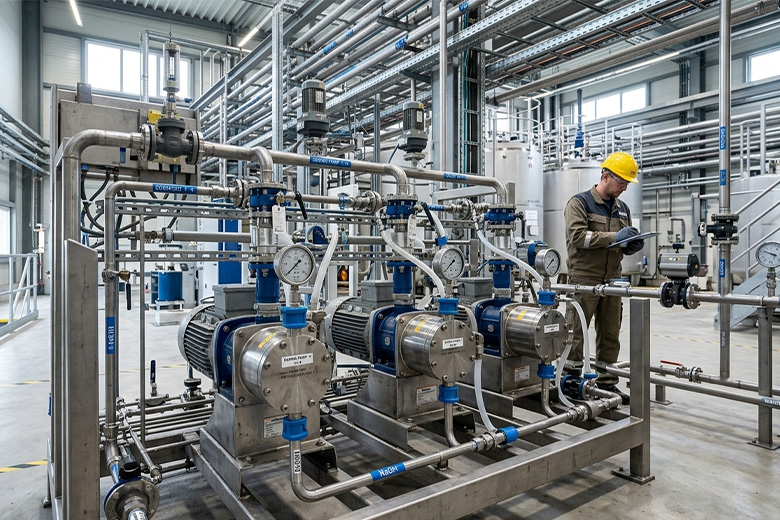
Chemical Metering & Dosing Pumps: Selecting the Right Type for Corrosive & Hazardous Fluids
A single wrong pump selection in a chemical dosing application doesn’t just cause inefficiency — it can trigger catastrophic equipment failure, regulatory violations, and serious safety incidents. Across industries such as chemical processing, desalination, power generation, and food processing, the correct dosing of aggressive, corrosive, and hazardous fluids is a non-negotiable process requirement.
Yet pump selection remains one of the most under-specified decisions in industrial procurement. Plant managers and procurement teams frequently face the same challenge: dozens of pump types on the market, each with overlapping claims, and insufficient guidance on which technology truly suits which fluid and application.
This guide breaks down the key chemical metering and dosing pump types, what makes each suitable for corrosive and hazardous fluid handling, and the critical selection criteria that separate a reliable installation from a costly one — whether your facility is in the UAE, Africa, Indonesia, South Asia, or anywhere else in the world.
What Is a Chemical Dosing Pump — and Why Does Selection Matter So Much?
A chemical dosing pump (also called a metering pump) delivers precise, controlled volumes of a chemical fluid into a process stream. The quantities are often small, but the impact of getting them wrong is large. Under-dosing in a water treatment plant can compromise the entire purification cycle. Over-dosing a corrosive chemical in food processing can render an entire batch unusable or unsafe.
Unlike standard centrifugal pumps, chemical metering pumps are engineered for:
High accuracy at low flow rates
Resistance to aggressive and reactive fluids
Consistent output regardless of back-pressure fluctuations
Safe containment of hazardous or toxic substances
This precision requirement is what makes material compatibility, seal design, and pump mechanism the three pillars of smart dosing pump selection.
The Main Types of Chemical Dosing Pumps
1. Diaphragm Metering Pumps
Diaphragm pumps are the most widely used chemical metering pumps in industrial settings — and for good reason. A flexible diaphragm creates a sealed pumping chamber, meaning the fluid never contacts the mechanical drive components. This makes them exceptionally well-suited to hazardous, toxic, and corrosive chemicals.
Best for: Chlorine dosing in water treatment, acid injection in desalination pre-treatment, chemical reagent dosing in pharmaceutical production.
Available in two sub-types:
- Mechanically actuated diaphragm pumps — cost-effective, suitable for moderate pressures and standard chemical duties.
- Hydraulically actuated diaphragm pumps — suited for higher pressures and more demanding process conditions, offering superior accuracy and longer diaphragm life.
Material considerations: Wetted components (diaphragm, valve balls, pump head) should be specified in PTFE, PVDF, or polypropylene depending on the chemical being handled. This is where many procurement errors occur — specifying a pump body material that doesn’t account for chemical compatibility leads to accelerated degradation and potential containment failure.
2. Peristaltic (Hose/Tube) Pumps
Peristaltic pumps operate by compressing a flexible tube or hose through rollers, pushing the fluid forward without any contact between the fluid and the pump mechanism. This is the defining advantage for extremely aggressive or shear-sensitive chemicals.
Best for: Sodium hypochlorite dosing, slurry chemicals, abrasive reagents, high-viscosity fluids, and applications where contamination-free fluid handling is essential.
Key advantage: Zero seal, no valve, and no contact with mechanical parts — eliminating the most common sources of leakage and contamination in corrosive fluid applications.
Limitation: Tube/hose wear requires scheduled replacement. Specifying the correct hose material (natural rubber, EPDM, silicone, Viton, or PTFE-lined) is critical based on chemical compatibility and operating temperature.
3. Solenoid-Driven Dosing Pumps
Solenoid pumps use an electromagnetic coil to drive a diaphragm back and forth at a controllable frequency, allowing precise flow rate adjustment without complex mechanical drives.
Best for: Lower-flow, lower-pressure chemical injection applications such as swimming pool treatment, small water treatment systems, cooling tower chemical dosing, and boiler feed chemical injection.
Advantage: Compact, economical, and easy to integrate with automated control systems — widely used in remote installations across Africa and Southeast Asia where simplicity and reliability in the field matter more than flow rate capacity.
4. Piston/Plunger Metering Pumps
Piston metering pumps deliver the highest pressure capability among dosing pump types and are used where both precision and high pressure are simultaneously required.
Best for: High-pressure chemical injection in power plants, chemical injection into high-pressure pipelines, and hydrate inhibitor injection in gas processing.
Material consideration: Piston pumps have dynamic seals that come into direct fluid contact — so seal material selection (PTFE packing, ceramic-coated pistons) is especially important for corrosive duties.
5. Gear and Progressing Cavity Pumps for Viscous Chemical Dosing
For highly viscous chemical products — polymer solutions, concentrated acids, or paste-like additives — gear pumps and progressing cavity (mono) pumps offer controlled, smooth flow without pulsation.
Best for: Polymer dosing in wastewater treatment, thick chemical additives in food processing, lime slurry dosing in industrial effluent treatment.
Critical Selection Criteria for Corrosive and Hazardous Fluid Applications
Choosing the right chemical dosing pump goes beyond pump type. Here are the five factors that determine whether a pump performs reliably over its service life or fails prematurely:
1. Chemical Compatibility
Every material the fluid contacts — the pump head, diaphragm, seals, valve balls, tubing, and fittings — must be chemically compatible with the process fluid. Always consult a chemical resistance chart for both the concentration and temperature of the chemical, not just the chemical name alone. Sulfuric acid at 10% concentration behaves very differently from 98% concentrated sulfuric acid.
2. Flow Rate and Dosing Accuracy
Define the minimum and maximum required flow rate, and ensure the pump operates in the mid-range of its capacity for best accuracy. Pumps running at the extreme edges of their range (very low or very high turndown ratios) deliver less consistent results.
3. Discharge Pressure
Account for system back-pressure, pipe friction losses, and any control valve pressure drops. Undersized discharge pressure rating is a common cause of dosing failure.
4. Containment and Leak Prevention
For toxic, carcinogenic, or environmentally regulated chemicals, double-diaphragm designs with leak detection or magnetic coupling options eliminate the risk of fugitive emissions and are often a regulatory requirement.
5. Control and Automation Integration
Modern metering pumps can be equipped with 4-20mA signal inputs, HART communication, or digital field bus protocols for integration into DCS or SCADA systems — important for facilities undergoing digital transformation in their process control infrastructure.
Industry Applications: Where Chemical Dosing Pump Selection Is Most Critical
Desalination Plants: Anti-scalant dosing, coagulant injection, and biocide dosing in SWRO systems require pumps that resist chlorine, aggressive acids, and oxidizing agents simultaneously. Material selection is non-negotiable.
Chemical Processing Plants: Acid and alkali neutralisation, catalyst injection, and reagent addition demand high chemical resistance combined with precise flow control across wide temperature ranges.
Power Plants: Boiler feed chemical dosing (oxygen scavengers, pH adjusters, scale inhibitors) requires reliable high-pressure injection with minimal downtime, often in high-temperature environments.
Food and Beverage Processing: CIP (Clean-In-Place) chemical dosing, sanitizer injection, and process chemical addition require FDA/food-grade wetted materials and contamination-free designs.
Water and Wastewater Treatment: Chlorine, alum, polymer, and pH-correction chemical dosing — typically high-volume, continuous duty with remote monitoring requirements.
How EuroIndustriel Simplifies Chemical Dosing Pump Procurement
Sourcing the right chemical dosing pump is rarely straightforward. Beyond the technical specification, procurement teams face challenges of supplier qualification, lead time uncertainty, counterfeit risk, and total cost optimization across the pump’s service life.
EuroIndustriel works with procurement and operations teams across the UAE, Middle East, Africa, Indonesia, Southeast Asia, India, and beyond — sourcing technically specified industrial equipment globally, not just regionally. Our approach combines supply market intelligence, supplier benchmarking, and material compatibility expertise to ensure that the pump specified is the pump delivered — with full documentation and quality assurance.
Whether you’re commissioning a new chemical dosing system, replacing aging metering pumps, or building a strategic stocking program for critical spares, EuroIndustriel’s procurement specialists provide end-to-end support from specification through delivery.
