


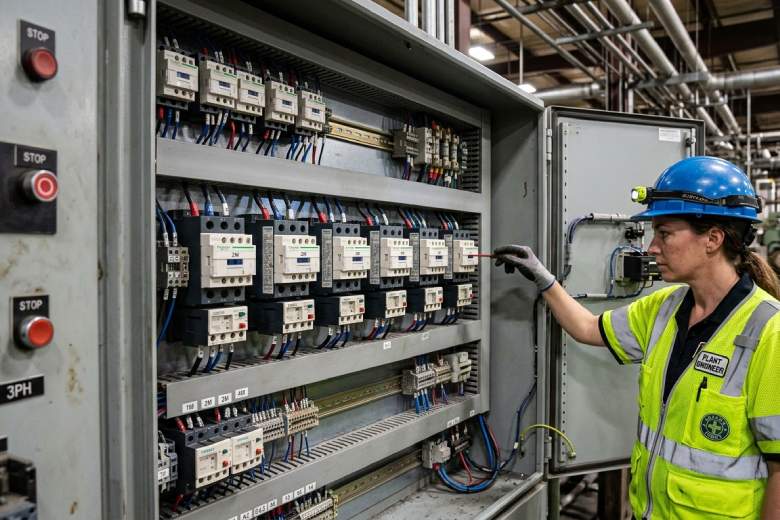
Contactor and Relay Selection for Industrial Motor Starters: What Every Plant Engineer Should Know
A 500kW boiler feed pump trips offline at 2 AM. The motor starter panel is fried. The culprit? A contactor that was undersized by one frame category — a procurement decision made three years ago by someone who picked the cheaper option without checking the utilisation category.
This is not a hypothetical. It is one of the most common and most avoidable causes of unplanned downtime across power plants, desalination facilities, food processing units, and chemical plants worldwide.
Contactor and relay selection for industrial motor starters is not a checkbox task. It is an engineering decision with direct consequences on equipment lifespan, energy efficiency, operational safety, and total plant uptime. Yet for many procurement and engineering teams, the selection process is rushed, under-specified, or driven entirely by price.
This guide cuts through the complexity. If you manage motor-driven systems — from a 15kW HVAC unit to a 1MW process pump — what follows will sharpen how you evaluate, specify, and procure these critical components.
Why the Right Motor Starter Components Define Plant Reliability
Every industrial motor requires a starter: a control system that manages the electrical sequence of switching, protecting the motor during start-up and operation. Within that starter, two components do the heaviest work — the contactor and the overload relay.
Get them right, and your motors run for their full design life. Get them wrong, and you are looking at coil failures, contact welding, nuisance tripping, or — in the worst cases — electrical fires and total motor burnout.
The economic stakes are real. Motor systems account for roughly 65–70% of industrial electrical energy consumption globally. In sectors like desalination and power generation, where large motors run continuously for months at a time, even a marginal mismatch in starter component ratings accelerates degradation that compounds over thousands of operating hours.
Key Insight: The contactor and the overload relay must be selected together, not independently. A correctly rated contactor paired with a poorly calibrated relay — or vice versa — still puts your motor at risk.
Understanding Contactors: More Than Just a Heavy-Duty Switch
A contactor is an electrically controlled switch used to make and break power circuits. Unlike a standard circuit breaker — which is designed to interrupt fault current — a contactor is engineered for frequent switching under load, sometimes thousands of operations per day in high-cycle applications.
The AC Utilisation Category: The Most Misunderstood Specification
When sizing contactors for motor starter applications, the utilisation category is the specification most frequently overlooked.
IEC 60947-4-1 defines the relevant categories:
- AC-1: Non-inductive or slightly inductive loads (resistive heating, lighting)
- AC-2: Slip-ring motors — starting, switching off
- AC-3: Squirrel-cage motors — starting, switching off during running (the most common industrial category)
- AC-4: Squirrel-cage motors — starting, plugging, inching (severe duty, reversing drives)
A contactor rated for AC-3 at 45kW may only be rated for AC-4 at 22kW. If your process requires frequent reversing or plugging — common in conveyors, hoists, and mixing applications — and you specify AC-3 contacts, you are buying a contactor that will fail prematurely under actual operating conditions.
Contactor Sizing: Current Rating vs. Motor Full Load Amps
The contactor’s thermal current rating (Ith) must exceed the motor’s full load amps (FLA) with appropriate headroom. A common starting point is sizing the contactor to handle 1.25x the motor FLA, but the actual selection must also account for ambient temperature, enclosure type, and duty cycle.
In high-ambient environments — prevalent across the Middle East, Southeast Asia, sub-Saharan Africa, and Indonesia — derating factors apply. A contactor rated for 63A at 40°C may need to be derated to 50A at 55°C. Ignoring this in tropical or desert climates is one of the most common procurement errors EuroIndustriel’s engineering team identifies when reviewing plant failure reports.
Overload Relays: The Last Line of Defence Before Motor Damage
If the contactor controls the switching, the overload relay is responsible for protection. It monitors motor current and disconnects the circuit when sustained overcurrent threatens the motor’s winding insulation.
Thermal Overload vs. Electronic Overload: Choosing the Right Type
Thermal overload relays use bimetallic strips that bend under heat generated by excess current. They are cost-effective, simple, and suitable for standard applications. They do have limitations: response time varies with ambient temperature, and they provide limited diagnostic feedback.
Electronic (solid-state) overload relays offer far greater precision and functionality:
- Adjustable trip class settings (Class 5 to Class 30)
- Phase imbalance and phase loss detection
- Ground fault protection
- Thermistor input for direct winding temperature monitoring
- SCADA/BMS communication via Modbus or Profibus
For critical motors — boiler feed pumps, high-pressure RO feed pumps, compressors, and centrifuge drives — electronic overload relays pay for themselves quickly through reduced false trips and early fault detection.
Trip Class Selection: Getting It Right for Your Load Profile
Trip class defines how quickly the relay trips under overload conditions. The selection must match your motor’s starting characteristics:
| Trip Class | Typical Application |
|---|---|
|
Class 10 |
Standard loads with short start times (under 5 seconds) |
|
Class 20 |
Normal motors with moderate starting loads |
|
Class 30 |
High-inertia loads — large fans, centrifuges, ball mills |
A Class 10 relay on a centrifuge will nuisance-trip during every start. A Class 30 relay on a standard pump will be too slow to protect the motor during a genuine overload. Both scenarios are preventable with correct specification.
Contactor and Relay Selection: A Practical Framework for Plant Engineers
Approaching motor starter component selection systematically eliminates the guesswork that leads to procurement errors.
Step 1 — Define the Motor Parameters Collect: kW rating, supply voltage, full load amps, starting current (typically 6–8x FLA for DOL), starting time, duty cycle, and ambient temperature at the installation location.
Step 2 — Identify the Application Category Classify the load: is it continuous, intermittent, or severe duty? Does the process require reversing, plugging, or jogging? This determines your IEC utilisation category.
Step 3 — Select the Contactor Match the contactor’s AC rating to your application category, with temperature derating applied. Verify mechanical life expectancy (number of operations) against your cycle requirements.
Step 4 — Select the Overload Relay Choose between thermal and electronic based on criticality and diagnostic needs. Set the current adjustment range to bracket your motor FLA. Select trip class based on motor starting time and load inertia.
Step 5 — Verify Coordination Confirm that the contactor and relay are from a coordinated range or verified as type-tested combinations per IEC 60947-4-1. Type-tested combinations — where the manufacturer has validated the pair under fault conditions — provide documented short-circuit withstand capability that individually selected components may not.
Step 6 — Factor in Spare Parts and Global Availability A technically perfect component choice becomes a liability if replacement parts are unavailable during a critical outage. Across operations in Africa, Indonesia, India, and the Gulf region, supply chain accessibility must be part of the selection criteria — not an afterthought.
The Global Procurement Perspective: Why Supplier Choice Matters as Much as Component Choice
Engineering teams often underestimate the procurement dimension of motor starter components. Sourcing from multiple, uncoordinated vendors leads to mixed brands across a panel board — creating warranty ambiguity, type-test gaps, and maintenance complexity.
EuroIndustriel works with plant engineers and procurement teams across desalination plants, power facilities, sugar mills, food processing units, and chemical processing facilities globally — across the UAE, Middle East, Africa, Indonesia, Southeast Asia, and India — to consolidate motor starter component sourcing under verified, coordinated supply chains.
The approach is simple: specify correctly, source globally, and ensure every component shipped meets the exact type-tested and standards-compliant specification the engineer approved. No substitutions without engineering sign-off. No grey-market alternatives dressed up in original packaging.
With premium brand partners including ABB, WEG, and Siemens, EuroIndustriel provides access to the full range of IEC-compliant contactors and overload relays — from standard AC-3 contactors for routine motor applications to electronic overload relays with advanced diagnostics for critical process motors.
Common Mistakes That Cost Plants Time and Money
Even experienced engineers make selection errors under procurement pressure. The most frequent ones:
- Specifying by motor kW alone — ignoring utilisation category and duty cycle
- Ignoring ambient temperature derating — particularly relevant in Gulf, African, and Southeast Asian climates
- Mixing brands without type-test verification — exposing the installation to unvalidated fault coordination
- Selecting thermal relays for critical motors — losing the diagnostic depth that prevents unplanned trips
- Buying on price from unverified distributors — receiving counterfeit or grey-market components with none of the specification guarantees
Precision Selection Protects More Than Just a Motor
Contactor and relay selection for industrial motor starters is one of those decisions that disappears into the background when done correctly — and becomes immediately, painfully visible when done wrong.
The plant engineer who specifies a correctly rated, type-tested, temperature-derated contactor and relay combination is not doing anything glamorous. They are doing exactly what keeps operations running, motors protected, and maintenance teams focused on scheduled work rather than emergency callouts.
At EuroIndustriel, we support engineering and procurement teams in getting these specifications right — and then sourcing the right components, from the right manufacturers, with full traceability and compliance documentation.
