


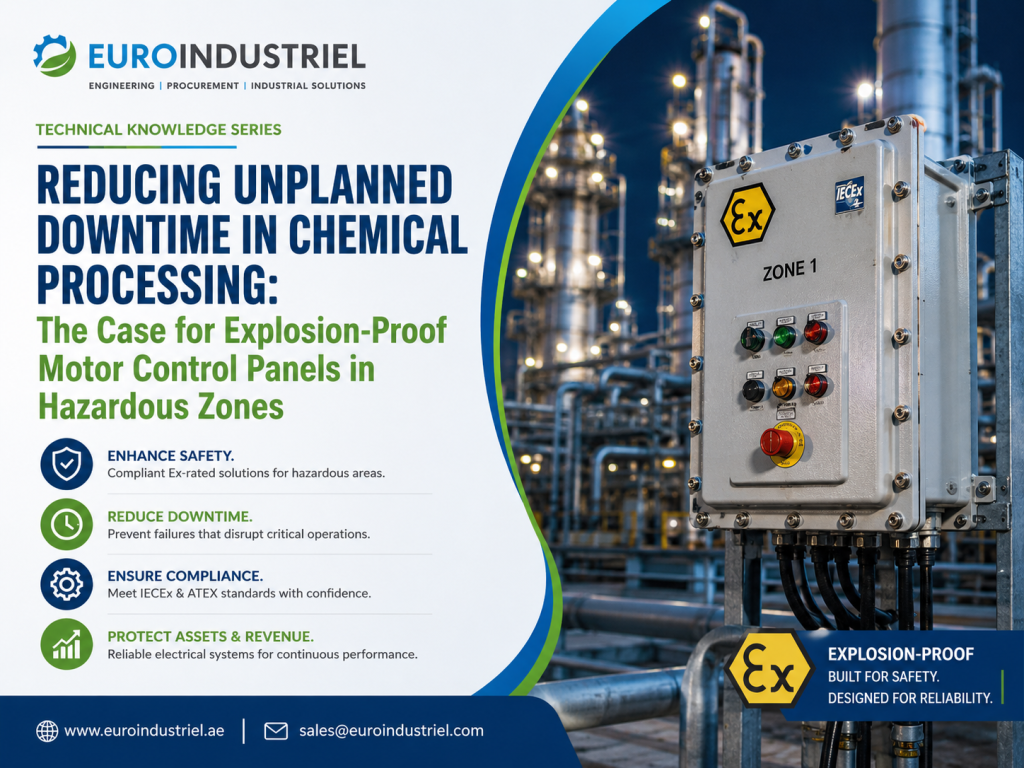
Reducing Unplanned Downtime in Chemical Processing: The Case for Explosion-Proof Motor Control Panels in Hazardous Zones
A solvent recovery unit at a specialty chemicals plant in Jubail Industrial City trips offline at 02:40 on a Tuesday. The immediate cause is a motor control panel fault on a transfer pump — an arc flash event inside an enclosure rated IP55, installed in a Zone 1 hazardous area. No ignition of the process atmosphere. No injuries. But the panel is destroyed, the pump circuit is dead, and the plant is down for 31 hours while a replacement enclosure is sourced, inspected, and commissioned.
The panel that failed was not explosion-proof. It had been installed as a temporary measure during a plant expansion three years earlier and never replaced with a compliant Ex d or Ex e enclosure. The original specification had called for IECEx Zone 1 rated equipment. Procurement had substituted an IP55 industrial panel on cost grounds, with a site modification note that was never formally closed.
Thirty-one hours of downtime on a solvent recovery unit. The replacement panel cost was negligible against the production loss and the regulatory notification that followed.
Across chemical processing facilities in the Middle East, North Africa, South Asia, and East Africa, the same pattern recurs: hazardous area electrical equipment — motor control panels in particular — is specified correctly at the engineering stage, substituted or deferred on cost grounds during procurement or commissioning, and then maintained in service through successive audit cycles by documentation workarounds. The compliance gap closes only when something fails.
What Hazardous Zone Classification Actually Requires of Electrical Equipment
The IEC 60079 series — adopted as the basis for both ATEX (EU) and IECEx (international) certification — classifies hazardous areas by the frequency and duration of explosive atmosphere presence. For gas and vapour hazards, the three zones are:
- Zone 0: Explosive atmosphere present continuously or for long periods. Requires Category 1 / Group IIC equipment in most chemical processing environments. Practical application: inside storage tanks, enclosed process vessels.
- Zone 1: Explosive atmosphere likely to occur in normal operation. Requires Category 2 / appropriate Ex protection concept. Practical application: pump rooms, compressor houses, loading bays, areas around flanged connections on solvent lines.
- Zone 2: Explosive atmosphere not likely in normal operation, but possible under abnormal conditions. Requires Category 3 equipment minimum. Practical application: open-air areas around Zone 1 equipment, cable trenches, drain pits.
For motor control panels specifically, the relevant protection concepts under IEC 60079 are Ex d (flameproof enclosure), Ex e (increased safety — for terminal boxes and junction enclosures), Ex p (pressurised enclosure — applicable for larger MCC assemblies), and Ex n (non-sparking — Zone 2 only). The correct selection depends on the zone classification, the gas group (IIA, IIB, IIC — reflecting the minimum ignition energy of the hazardous substance), and the temperature class (T1 through T6 — the maximum surface temperature the equipment may reach).
A standard industrial MCC enclosure — regardless of IP rating — satisfies none of these protection concepts. IP55 or IP65 means dust and water ingress protection. It says nothing about the ability of the enclosure to contain an internal arc without igniting a surrounding flammable atmosphere, which is what Ex d certification specifically tests and certifies.
Key Insight: IP rating and Ex rating are not the same thing. A panel can be IP65 and completely unacceptable for Zone 1 installation. This distinction is the source of more compliance documentation errors in chemical plant electrical systems than any other single specification mistake.
Why Motor Control Panels Carry the Highest Electrical Risk in Hazardous Zones
Among the electrical equipment categories installed in chemical processing hazardous zones — junction boxes, lighting fittings, sensors, junction enclosures — motor control panels represent the highest risk concentration for two reasons:
Internal arc energy. An MCC contains contactors, overload relays, circuit breakers, and bus bars — all potential sources of arc flash energy under fault conditions. The energy release from a motor starter fault inside a non-Ex enclosure, in a Zone 1 atmosphere, is sufficient to ignite most common process solvents and gases. The enclosure does not need to be directly open to the atmosphere — a cable entry improperly sealed, or a panel door opened during maintenance, is sufficient.
Maintenance intervention frequency. Motor control panels are accessed regularly — for overload reset, contactor replacement, fuse inspection, and parameter adjustment. Each maintenance intervention in a Zone 1 environment with a non-Ex enclosure is a potential ignition event. The probability is low per intervention, but across a plant with dozens of panels and hundreds of maintenance events per year, the cumulative risk is not theoretical.
The consequence of this risk concentration is that motor control panels in hazardous zones are the category of electrical equipment most frequently identified in ATEX/IECEx compliance audits as non-conforming — and the category where rectification has the most direct impact on plant safety and insurance standing.
Common Specification and Installation Failures: What Compliance Audits Find
EuroIndustriel Electric’s engineering team has supported compliance reviews across chemical processing facilities in the UAE, Saudi Arabia, Oman, India, and East Africa. The non-conformance categories that appear consistently across audits, regardless of plant age or operator size, are:
- Zone boundary creep. Hazardous area drawings produced at plant commissioning are not updated as process modifications are made. A Zone 2 area becomes de facto Zone 1 after a solvent handling point is relocated, but the electrical equipment classification is not revised. Motor control panels originally acceptable for Zone 2 are now installed in an unclassified Zone 1 environment.
- Incorrect gas group selection. A panel certified for Gas Group IIA (propane equivalent) installed in a Group IIB (ethylene equivalent) or Group IIC (hydrogen equivalent) environment. The Ex d enclosure may contain an internal arc — but if the gas group is wrong, the minimum ignition energy of the process atmosphere is lower than the enclosure was designed to suppress. The certificate is valid. The installation is not.
- Temperature class mismatch. Motor control panels generate heat in service. A T4 rated panel (maximum surface temperature 135°C) is not acceptable in an environment where the process material has an auto-ignition temperature below 135°C — which includes several common solvents and intermediates in specialty chemical processing. Temperature class selection requires knowledge of the process materials, not only of the electrical equipment.
- Cable entry integrity failures. An Ex d enclosure with an improperly certified or incorrectly installed cable gland provides no explosion protection. Cable gland certification must match the enclosure Ex concept, the cable type, and the zone. A gland substituted during maintenance with a non-Ex rated equivalent invalidates the enclosure certification for the installation — regardless of the enclosure’s own certificate.
- Documentation gaps for Ex equipment. IECEx and ATEX compliance requires not only correct equipment specification but maintained documentation: Ex certificates, installation drawings with zone boundaries, equipment registers with gas group and temperature class notation, and inspection records per IEC 60079-17. In most non-conforming installations reviewed, the equipment is physically adequate but the documentation trail cannot support an insurance claim or a regulatory audit.
Ex Protection Concepts for Motor Control Panels — Quick Reference
Protection Concept | IEC 60079 Part | Applicable Zone | How it Works | Typical MCC Use |
Ex d — Flameproof | IEC 60079-1 | Zone 1 & 2 | Enclosure contains internal arc; joints flame-quench before propagation | Individual motor starters; smaller MCC sections |
Ex e — Increased Safety | IEC 60079-7 | Zone 1 & 2 | Eliminates potential ignition sources; enhanced clearances and terminals | Terminal boxes; junction enclosures; passive MCC sections |
Ex p — Pressurisation | IEC 60079-2 | Zone 1 & 2 | Internal overpressure with purged clean air or inert gas prevents ingress of hazardous atmosphere | Large MCC assemblies; full motor control centres with VFDs |
Ex n — Non-Sparking | IEC 60079-15 | Zone 2 only | Designed not to produce sparks or hot surfaces under normal operation | Zone 2 motor starters where arc energy is low |
Before the Compliance Audit: What Plant Engineers Should Verify Now
With ATEX and IECEx compliance reviews intensifying across MEA industrial zones in H2 planning cycles, the most effective posture is to conduct a self-audit before the formal review. The checks that identify the highest-consequence non-conformances in the shortest time are:
- Cross-reference the hazardous area drawing revision date against the last process modification date. If the area classification drawing is older than the most recent P&ID revision, zone boundaries may have changed. This is the single most common root cause of misclassified electrical installations.
- Pull the Ex certificates for every motor control panel in Zone 1 and Zone 2 areas. Verify that the certificate gas group matches the process materials present in that zone, and that the temperature class is appropriate for the lowest auto-ignition temperature of those materials. These two checks can be completed from documentation without physical inspection.
- Inspect cable gland certifications on Zone 1 panels. Remove a representative sample of gland blanking plugs and verify that the gland type, Ex marking, and cable diameter match the installation. A gland that has been replaced with a non-Ex item — even once — is a non-conformance that invalidates the panel’s installation compliance.
- Check that Ex equipment inspection records exist and are current to IEC 60079-17. The standard requires initial inspection at commissioning, and periodic detailed inspection thereafter — annually for Zone 1, every three years for Zone 2 as a minimum. Missing inspection records are a documentation non-conformance even where the physical equipment is correct.
- Identify any equipment installed on a ‘temporary’ basis in a hazardous zone. Temporary equipment that has been in service for more than one audit cycle without replacement is almost always a compliance gap. Identify it, document it, and programme replacement before the formal review.
Key Insight: A compliance audit finds what the documentation says. A self-audit finds what the documentation does not say — which is always the more important list.
Specifying Correctly: Why Ex Panel Procurement Requires a Different Process
Ex-rated motor control panels are not catalogue items. Correct specification requires: the zone classification and gas group for the installation location, the process material auto-ignition temperature for temperature class selection, the motor load data (kW, starting current, duty cycle) for contactor and overload sizing, and the protection concept appropriate for the panel function and enclosure size.
The consequence of getting any of these inputs wrong is a panel that is either non-compliant (safety and regulatory risk) or over-engineered for the zone (unnecessary cost). Neither outcome is acceptable in a chemical plant environment where both safety performance and capital budget discipline are measurable against benchmarks.
EuroIndustriel Electric supplies Ex-rated motor control panels and associated hazardous area electrical equipment — Ex d flameproof enclosures, Ex e terminal and junction assemblies, Ex p pressurised MCC solutions, and Ex certified cable glands and accessories — certified to both ATEX and IECEx standards for Zone 1 and Zone 2 applications across chemical processing, oil and gas, pharmaceuticals, and solvent handling facilities.
Our engineering team works with plant electrical engineers and EPC contractors to validate zone classification, select the appropriate protection concept, size the panel correctly for the motor load, and produce the documentation package — Ex data sheets, zone drawing references, certificate cross-references — that supports both commissioning sign-off and ongoing IEC 60079-17 inspection compliance.
For facilities in the UAE, Saudi Arabia, Oman, Qatar, India, and East Africa approaching H2 compliance reviews, early engagement on equipment specification eliminates the two most expensive outcomes: non-compliant equipment that must be replaced before the audit, and Ex-rated equipment ordered incorrectly and requiring re-specification after delivery.
The Cost of Non-Compliance Is Always Higher Than the Cost of Compliance
The Jubail plant that ran 31 hours of unplanned downtime on a solvent recovery unit did not make a reckless decision. It made a procurement substitution that looked reasonable at the time, was not adequately reviewed at commissioning, and was not caught in subsequent audit cycles. The cost of the correct Ex d panel at original installation was a fraction of the downtime cost, the regulatory notification process, and the insurance implications that followed.
Motor control panels in hazardous zones are not an area where the cost-compliance trade-off favours deferral. The compliance baseline — correct Ex concept, correct gas group, correct temperature class, correct documentation — is the minimum. It is also, when specified and procured correctly from the start, a manageable cost.
To discuss Ex panel specification for your facility or to support a pre-audit compliance review, contact EuroIndustriel Electric at sales@euroindustriel.com or visit euroindustriel.ae.
