


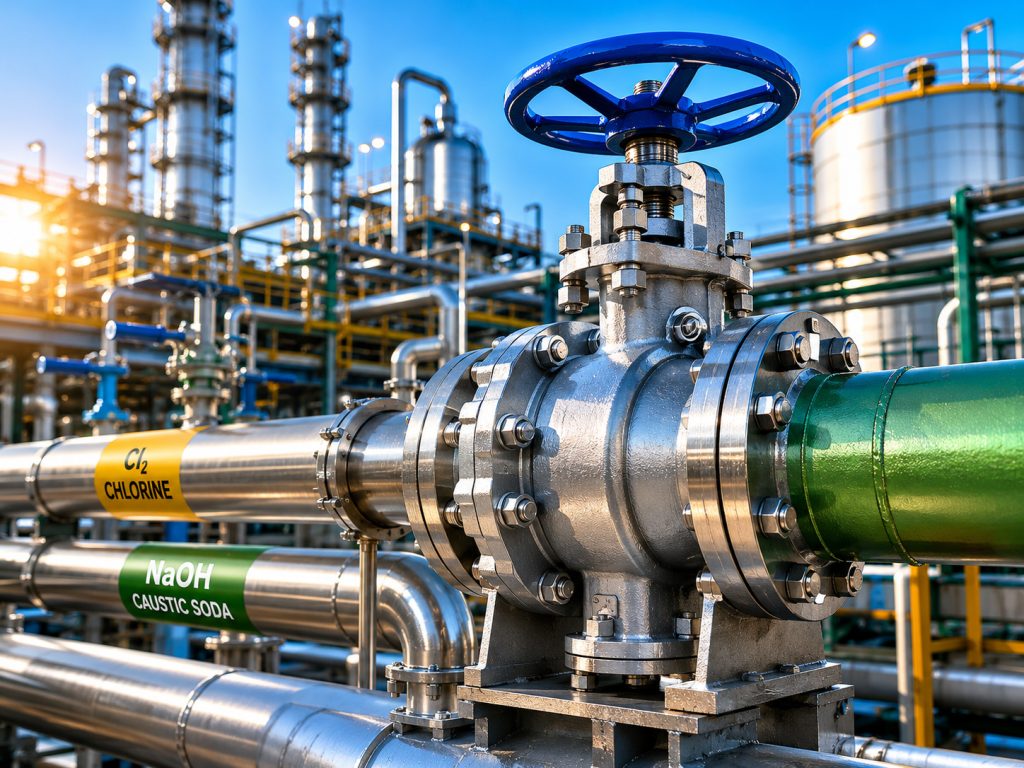
Industrial Valves for Chlorine and Caustic Soda Handling: Corrosion-Resistant Specifications That Prevent Catastrophic Failure
A ball valve on the liquid chlorine header at a chlor-alkali plant in Gujarat fails at the stem seal during a partial-load restart. Wet chlorine vapour escapes into a confined pipe gallery. The facility loses four hours of production, triggers a Tier 2 emergency response, and faces a mandatory safety audit before restart authorisation. The root cause: a valve specified for dry chlorine service had been installed in a wet chlorine line, and nobody in the procurement chain had flagged the distinction. The corrosion was not sudden. It was months in the making.
This is the failure mode that engineers designing or auditing chlor-alkali and petrochemical assets across India and the Middle East must actively engineer out of their systems — before the next mid-year turnaround reveals it as a crater rather than a crack.
Why Chlorine and Caustic Soda Demand Separate Material Strategies
Chlorine and caustic soda are the two primary outputs of the chlor-alkali electrolysis process, and they impose fundamentally different — sometimes opposite — demands on valve materials. Getting them confused at the specification stage is a recurring source of unplanned downtime across facilities from Dahej to Dubai Industrial City.
Wet chlorine (chlorine gas saturated with moisture, or liquid chlorine) is among the most aggressively corrosive media in industrial chemistry. It attacks most ferrous and non-ferrous metals, generating metal chlorides and accelerating stress corrosion cracking. Dry chlorine, by contrast, can be handled by carbon steel above a threshold flow velocity, but any moisture ingress immediately shifts the corrosion mechanism. Caustic soda (NaOH), particularly in concentrations above 30% and temperatures exceeding 60°C, triggers caustic stress corrosion cracking in carbon steel and certain stainless alloys — a phenomenon often invisible until fracture.
These are not interchangeable service conditions. They require separate valve material matrices.
Material Selection: What the Standards Actually Require
ASME B16.34 governs pressure-temperature ratings for valves, but material suitability for corrosive media requires layering in NACE MR0103 (materials for H₂S-containing environments typical in downstream chlorine consumers) and process-specific corrosion data. For ISO-aligned procurement, EN 12266-1 provides the test and acceptance criteria framework for industrial valves in demanding services.
Service | Recommended Body Material | Trim Material | Seat/Seal Material | Avoid |
Wet Chlorine (gas/liquid) | Hastelloy C-276, Titanium Grade 2 | Hastelloy C-276 | PTFE, PVDF | Carbon steel, 316 SS |
Dry Chlorine (gas) | Carbon steel (low velocity), Monel 400 | Monel 400 | PTFE | Copper alloys (ignition risk) |
Caustic Soda ≤30%, ≤60°C | 316L Stainless Steel, Duplex UNS S31803 | 316L SS | EPDM, PTFE | Carbon steel unlined |
Caustic Soda >30%, >60°C | Nickel 200/201, Hastelloy C-276 | Nickel 200 | PTFE | Standard austenitic SS |
Hypochlorite (NaOCl) | Titanium Grade 2, CPVC-lined | Titanium | PTFE | All carbon steel, most SS grades |
**Key Insight:** Nickel 200 is the benchmark alloy for hot concentrated caustic service, but it is restricted to below 315°C to avoid graphitisation. Nickel 201 (low-carbon variant) is the correct selection above 260°C.
Duplex stainless steel to ASTM A890 Grade 4A (UNS S31803) is frequently specified for dilute caustic and process water in chlor-alkali plants because of its combined resistance to chloride stress corrosion cracking and general corrosion, alongside its mechanical strength advantage over austenitic grades.
Valve Type Selection for Each Service Phase
Not all valve geometries perform equally in chlorine and caustic circuits. The internal geometry determines flush characteristics, dead-leg volume, and seat loading — all of which influence corrosion rate and cleanability.
- Full-bore ball valves in PTFE-seated Hastelloy C-276 are preferred for liquid chlorine headers where full isolation and piggability matter. Verify fire-safe certification per ISO 10497 for any chlorine service valve.
- Diaphragm valves with PTFE or PVDF liners are the standard choice for hypochlorite and dilute caustic, eliminating packing glands entirely and removing stem corrosion as a failure path.
- Butterfly valves are acceptable for caustic service below 60°C in lined configurations (rubber or PTFE-lined disc and body), but should not be used in concentrated hot caustic without alloy construction.
- Globe valves in Nickel 200 are specified for throttling in hot concentrated NaOH loops where precise flow control is required and the operating conditions preclude elastomeric diaphragm materials.
- Plug valves with sleeved PTFE liners find application in chlorine gas distribution headers, where their wiping action limits particulate accumulation, but stem sealing integrity must be validated against ISO 15848-1 fugitive emission class A (≤50 ppm) for any chlorine service.
**Key Insight:** ISO 15848-1 type-tested fugitive emission performance is not a regulatory luxury in chlorine service — it is the minimum credible evidence that the stem sealing system was validated under representative mechanical cycling and thermal conditions.
Procurement Red Flags During Turnaround Reviews
Mid-year turnarounds in chlor-alkali plants across Oman, Saudi Arabia, and Gujarat are typically the only scheduled window to assess valve condition before another 12–18 months of continuous service. Procurement teams and inspection engineers should treat the following as immediate re-specification triggers:
- Pitting on 316 SS valve bodies in wet chlorine service: the alloy was not appropriate for this service to begin with. Replace with Hastelloy or Titanium.
- Discolouration or swelling of elastomeric seats in caustic loops above 50°C: indicates seat material incompatibility or temperature exceedance. Review operating conditions before re-ordering like-for-like.
- Evidence of thread corrosion at bonnet-to-body joints in diaphragm valves: this indicates chloride ingress from the process side and often precedes diaphragm failure.
- Any valve in chlorine service that cannot produce a current type-test certificate per EN 12266-1 or equivalent.
The absence of documentation is itself a specification failure.
Building a Defensible Valve Specification
A robust specification for chlorine and caustic soda industrial valves must address six dimensions:
- Process fluid state — wet vs. dry chlorine, concentration and temperature of NaOH, presence of hypochlorite
- Pressure-temperature class — per ASME B16.34 class ratings
- Body and trim alloy — with explicit reference to UNS designations, not trade names
- Seat and seal material — with temperature and chemical compatibility confirmation
- Fugitive emission class — ISO 15848-1 Class A for chlorine, Class B minimum for caustic
- Testing and certification — EN 12266-1 shell test, seat leakage, and operational torque data
Vetta Valves, EuroIndustriel’s industrial valve sub-brand, maintains pre-qualified configurations in Hastelloy C-276, Titanium Grade 2, Nickel 200/201, and duplex stainless across ball, diaphragm, and globe geometries, type-tested and documented for chlor-alkali service.
The Audit Window Is the Specification Opportunity
Turnarounds do not last. The six-to-eight week window when chlorine and caustic lines are depressurised and accessible is the only practical moment to make material corrections without production risk. Facilities that use that window only for like-for-like replacement consistently carry forward the same corrosion vulnerabilities into the next cycle.
Engineers reviewing valve registers ahead of 2026 mid-year audits in India or the Middle East are encouraged to benchmark their current specifications against the material matrix and testing requirements outlined here, and to contact the EuroIndustriel technical team at sales@euroindustriel.com or +91 9319083345 to discuss application-specific procurement requirements with alloy-verified lead times.
