


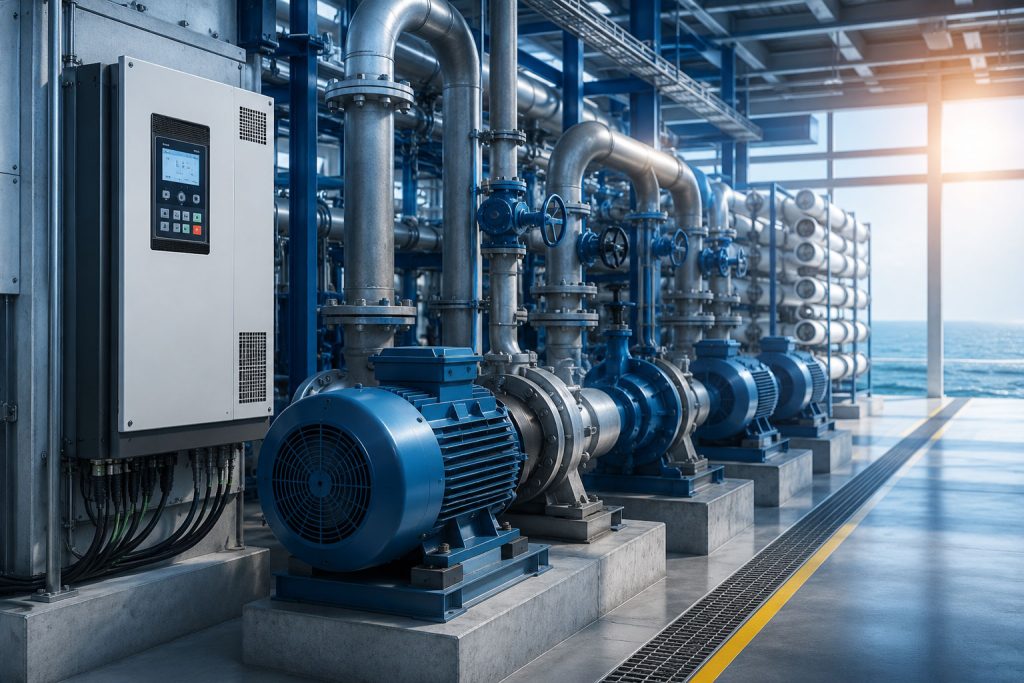
Variable Frequency Drives in Desalination Pump Stations: How GCC Facilities Are Cutting Energy Costs at Scale
Saudi Arabia’s National Water Company operates intake and transfer pump stations where a single 1,200 kW seawater feed pump running at full speed for 8,760 hours annually can consume upward of SAR 2.8 million in electricity — at the current industrial tariff of SAR 0.18/kWh — before demand charges are applied. Multiply that across a multi-train SWRO facility with eight to twelve such pumps, and energy becomes the dominant operational cost, often exceeding 40% of total plant expenditure. With the UAE enforcing its Net Zero 2050 target and Saudi Vision 2030 embedding specific energy intensity benchmarks into desalination procurement mandates, plant operators are no longer treating energy audits as optional reviews. They are urgent commercial imperatives.
Variable frequency drives are consistently the highest-return intervention identified during those audits. Not because the technology is new — it is not — but because desalination pump stations present the specific hydraulic conditions under which VFD control delivers compressive savings that fixed-speed operation structurally cannot match.
The Affinity Law Case: Why Partial-Speed Operation Changes the Arithmetic
The governing principle is the affinity law, and it is not approximate. It is mathematically exact for centrifugal pump behaviour. When pump shaft speed is reduced to 80% of rated speed, flow reduces proportionally to 80%, head reduces to 64% of rated head, and — critically — power consumption drops to 51.2% of full-load demand. A pump drawing 800 kW at full speed draws approximately 410 kW at 80% speed. At Dewa’s current commercial tariff of AED 0.38/kWh, that single pump saves AED 3,117 per day of partial-load operation.
Desalination plants are not static-demand facilities. Permeate output requirements vary with contractual delivery schedules, seasonal population peaks, and inter-train maintenance windows. During off-peak hours, SWRO feed pumps and high-pressure pumps frequently operate against reduced demand — conditions where throttle valves or bypass circuits absorb excess energy as heat and pressure drop rather than useful work. A VFD eliminates that waste entirely by matching shaft speed to actual process demand.
**Key Insight:** A throttle valve controlling flow at 70% capacity wastes approximately 30% of motor input power as hydraulic resistance. A VFD achieving the same flow reduction wastes less than 3% in drive losses. The differential is structural, not marginal.
Harmonic Distortion and Power Quality: The Specification Requirement Plant Engineers Must Not Overlook
Installing a VFD without addressing harmonic distortion is an incomplete engineering decision. Variable frequency drives generate current harmonics — primarily the 5th and 7th order — that propagate back into the facility’s distribution system. In large desalination facilities with multiple drives on a shared MV bus, total harmonic distortion (THD) can exceed 15% if drives are specified without appropriate mitigation.
IEEE 519-2022 sets the accepted limit at 5% THD at the point of common coupling for most industrial systems. Exceeding this causes transformer heating, interference with protection relays, and accelerated insulation degradation in co-located motors — all of which translate directly to unplanned downtime in a facility where production continuity is a contractual obligation.
Correct specification requires one or more of the following mitigation approaches:
- Active front-end (AFE) rectification — eliminates the dominant harmonic orders at source; the preferred approach for drives above 200 kW in sensitive distribution environments
- 12-pulse or 18-pulse transformer configurations — phase-shifted inputs that cancel harmonic pairs; cost-effective for fixed-speed applications with predictable load profiles
- Passive LC or LCL filters — lower-cost addition for smaller drives where THD budget permits
- Reactor-equipped drive cabinets (3–5% impedance line reactors) — minimum baseline requirement for any VFD installation feeding into a shared bus
For offshore intake structures and below-deck pump rooms common in Qatar’s and Abu Dhabi’s coastal desalination stations, IP54 to IP65-rated drive enclosures are a baseline environmental requirement. Where chemical dosing areas or fuel gas systems are co-located, ATEX Zone 2 compliance under IEC 60079 becomes mandatory for both the drive and its field wiring.
Motor Efficiency: IE3 and IE4 as the Starting Baseline
A VFD operating a IE2-class motor recovers significant energy at the drive level but leaves substantial efficiency unrealised at the motor itself. The IEC 60034-30-1 standard classifies motor efficiency tiers, and the engineering and commercial case for specifying IE3 (Premium Efficiency) or IE4 (Super Premium Efficiency) motors as the companion asset to VFD retrofits is now unambiguous. In a 315 kW motor application, the efficiency difference between IE2 and IE4 at 75% load is approximately 1.8 percentage points — roughly 5.7 kW of continuous saving per motor, or AED 78,000 annually at Dewa tariff rates.
IEC 61800-5-1 governs the safety requirements for adjustable speed electrical power drive systems and defines the type-tested parameters that a procurement specification must reference: dielectric withstand, protective bonding, thermal protection, and overvoltage category. Drives without documented type-tested compliance to this standard should not enter the procurement consideration set for critical pump duty applications, regardless of unit price.
Comparative Energy and Payback Performance: Typical SWRO Application
The following table illustrates representative performance parameters for a mid-scale SWRO feed pump station operating at 50% to 90% of design flow for 60% of annual hours — a realistic operating profile for a GCC municipal desalination facility.
Parameter | Fixed-Speed (Throttled) | VFD-Controlled | Variance |
Motor Rating | 630 kW | 630 kW | — |
Average Operating Load | 630 kW | 342 kW | −46% |
Annual Energy Consumption | 5,511 MWh | 2,996 MWh | −2,515 MWh |
Annual Energy Cost (AED 0.38/kWh) | AED 2,094,180 | AED 1,138,480 | −AED 955,700 |
VFD + Installation Capital Cost | — | AED 680,000 | — |
Simple Payback Period | — | **8.6 months** | — |
5-Year Net Saving | — | AED 4,098,500 | — |
Payback periods below twelve months are consistently reproducible in high-utilisation pump applications across Oman’s PAEW network and Saudi Aramco’s utilities infrastructure where pump duty cycles involve sustained partial-load operation.
Drive Selection Criteria for Desalination Duty
When preparing a VFD specification for seawater service pump applications, the following criteria define a defensible procurement framework:
- Torque characteristic — confirm variable torque (VT) mode capability with minimum 150% overload for 60 seconds to handle pump start-up against system pressure
- Input voltage tolerance — GCC grid fluctuation can reach ±10%; specify drives rated for 380–415 V ±15% input tolerance
- Altitude and ambient derating — coastal installations near sea level require no altitude derating, but confirmed ambient ratings to 55°C are mandatory for inland pump stations in UAE and Saudi Arabia
- EMC classification — minimum Category C3 per IEC 61800-3 for industrial environments
- Protection class — IP54 minimum for enclosed pump rooms; IP65 for exposed coastal installations
- Communication protocol — Modbus RTU or Profibus DP integration with SCADA is standard for modern desalination control architectures
**Key Insight:** Specifying a VFD for desalination duty without confirming SCADA integration protocol compatibility is a commissioning risk. Remote speed reference and process PID feedback are not optional features in automated multi-train facilities — they are functional requirements.
Procurement and Engineering Support
EuroIndustriel Electric supplies type-tested variable frequency drives for heavy-duty pump and fan applications across GCC industrial facilities, with technical documentation structured to support IEC 61800-5-1 and IEEE 519 compliance verification during the engineering review stage. Broader project integration — encompassing pump selection, valve specification, and system-level energy modelling — is coordinated through EuroIndustriel’s technical procurement team.
If your facility has not conducted a formal energy audit against peak summer load conditions, the window before Q3 2026 peak demand is closing. Contact the engineering team at [sales@euroindustriel.ae](mailto:sales@euroindustriel.ae) or visit [euroindustriel.ae](https://euroindustriel.ae) to discuss drive specification, total cost of ownership modelling, and procurement timelines aligned to your next planned maintenance window.
